
The airways are designed to keep foreign matter out. Mucociliary clearance removes trapped particles within 15 minutes, the nasal passages form a labyrinth that intercepts most sprays before they reach their target, and the lungs require droplets measured in single-digit micrometres to achieve meaningful deposition. Soft mist technology addresses each of these constraints by placing precise control over droplet size at the centre of device design, and applying that control across the full range of airway targets from the olfactory region down to the deep lung.

The respiratory system serves a narrow physiological purpose: to warm and filter air and exchange oxygen for carbon dioxide. Every structural feature of the airways reflects that purpose and creates a corresponding obstacle for drug delivery. The mucus lining traps particles. The ciliated epithelium moves them back out. The nasal passages narrow into channels that deflect anything larger than a very fine mist. The lungs sit behind approximately 20 centimetres of airway architecture that most drug particles never traverse. Understanding these obstacles is what makes targeting meaningful. The nasal cavity contains two distinct regions of pharmaceutical interest: the larger respiratory region, where the highly vascularised mucosa provides access to systemic circulation, and the olfactory region at the very top of the nasal cavity, where exposed neurons create a direct pathway to the brain. Below the nasal cavity, the larynx represents a frequently overlooked target for hydration and local treatment, and beyond it the lungs offer both a vast absorptive surface of approximately 80 square metres for systemic delivery and a site of direct treatment for respiratory conditions. Each of these targets is at a different depth, requires different particle characteristics to reach, and presents its own clearance and absorption dynamics. Particle size governs all of it. Droplets of 50 to 100 micrometres will not penetrate far and are likely to provoke a cough response. Droplets of 10 to 20 micrometres can reach the olfactory region. Laryngeal targeting requires particles in a similar fine range. Pulmonary delivery demands droplets between 0.5 and 4 micrometres. Below 0.5 micrometres, the aerosol behaves like a gas and is simply exhaled without meaningful surface contact. The window for effective pulmonary delivery is therefore narrow, and hitting it requires a delivery system engineered to produce droplets within that specific range.
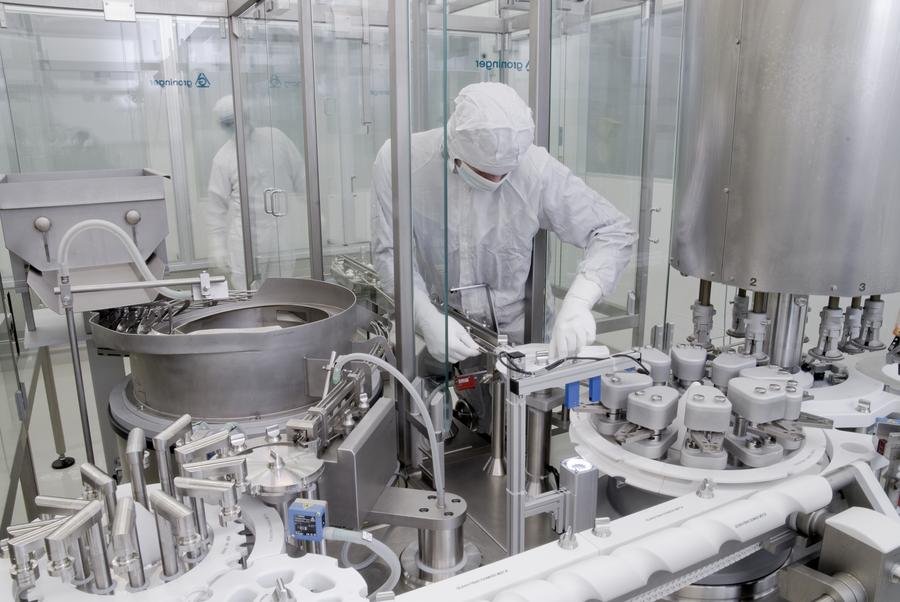
Class A clean room filling line, Ursatec preservative-free production facility.
Metered dose inhalers deliver their medication in approximately 0.3 seconds. The propellant, a fluorinated compound with a boiling point near room temperature, evaporates almost instantly on actuation, releasing a fast cold spray that the patient must inhale at precisely the right moment. The coordination this demands is not trivial. Users who cannot synchronise their inhalation with actuation deposit a significant proportion of their dose on the tongue or in the throat rather than in the lungs, which is where the drug needs to be.
Dry powder inhalers remove the propellant but introduce a different constraint: they require forceful inhalation to break up and carry the powder into the lung. For patients with asthma or COPD, precisely the populations most likely to need these devices, generating that inspiratory force may be difficult or impossible during an acute episode. Breath-activated variants of the metered dose inhaler address the timing problem but not the inspiratory force problem. Neither format is reliably usable by small children or patients with compromised respiratory function. Nebulizers solve both problems by generating a continuous soft mist that the patient breathes normally over several minutes. They require no coordination and no inspiratory effort. The cost is size, complexity, electricity dependence and the volume of medication consumed, most of which is inhaled and exhaled without effective deposition. They are well suited to clinical settings but present practical barriers for patients managing chronic conditions at home.
“With the soft mist inhaler, coordination is not so critical. You breathe in normally, release the spray, and it will travel to your target. There is nothing you can do wrong, and our user study confirmed exactly that.”
Christian Vaaler, Project Manager Regulatory Affairs and Development, Ursatec
The physical principle that governs soft mist generation is Rayleigh breakup. A liquid jet forced through a small orifice is less stable than the droplets it will form: the surface energy of the jet is higher than the combined surface energy of the resulting droplet array. Any disturbance, however small, initiates breakup. The resulting droplet diameter is predictably approximately 1.9 times the diameter of the originating liquid jet, which is itself determined by the diameter of the orifice through which it was forced. The practical consequence is that droplet size can be controlled with precision by controlling orifice diameter. Ursatec’s Soft Breezer platform uses this principle directly, with different spray head configurations producing different droplet size distributions from the same device form factor. The Soft Breezer Lung variant produces a median particle size of approximately 4 micrometres, placing it within the optimal range for pulmonary delivery. The Soft Breezer Larynx produces a somewhat coarser mist that targets the upper airway. The ultra-soft nasal variant is tuned for olfactory delivery, and in fluorescent dye deposition studies using a transparent nasal model, achieves approximately 40% deposition in the olfactory region compared to 14% for a standard nasal spray. For any application where the target is the olfactory region, a threefold improvement in on-target deposition is clinically meaningful. The platform also accommodates an infant adapter designed to resemble a pacifier, allowing soft mist delivery to patients who cannot self-administer. This extends the usable patient population across the full age range, including neonates and small children, for whom nebulizer-based treatment has historically been the only viable alternative. The device requires no electricity, fits in a pocket, and produces its spray over approximately one to two seconds rather than a fraction of a second, giving patients sufficient time to breathe in naturally and receive the dose as intended.
A soft mist inhaler without preservatives requires a fundamentally different production approach. The elimination of antimicrobial agents from the formulation means that every source of contamination must be controlled from the point of manufacture rather than managed chemically inside the filled product. Plastic components must be moulded in clean room conditions. Sterilisation cycles must be validated before primary packaging parts enter the filling environment. Bulk formulation must be sterilised by filtration or autoclaving as appropriate to the molecule. Filling takes place under Class A conditions with controlled airlocks between each stage.

Preservative-free assembly and filling line, Ursatec production facility.
The rationale for this investment is straightforward: preservative agents designed to kill microorganisms inside a formulation do not stop acting when the product is applied to mucosal tissue. Regular use of preserved nasal sprays or inhalers introduces antimicrobial compounds to the microbiome of the airway, reducing bacterial diversity and increasing susceptibility to external stressors including allergens, pollutants and infection. The human microbiome of the airways exists in a balanced state that preservatives disrupt. Preservative-free formulations avoid this disruption, which is of particular relevance for patients using inhaled medications on a daily or chronic basis. Ursatec has operated as a preservative-free specialist for over 30 years, with more than two billion units of preservative-free products sold globally and a commercial track record spanning nasal sprays, cosmetics and, increasingly, respiratory inhalation solutions. The Soft Breezer platform represents the extension of that manufacturing philosophy into inhaled drug delivery, bringing the same microbiological safety standards that have defined Ursatec’s nasal spray portfolio to a device class where they have not historically been standard.
“Any kind of drug does nothing if it is not in the place where it is supposed to be. Delivery is really key to success, and with the Soft Breezer we have a versatile platform that can be customised to address many specific therapeutic challenges.”
Christian Vaaler, Project Manager Regulatory Affairs and Development, Ursatec
Watch the webinar on demand The full presentation on soft mist inhalation technology, airway targeting and the Soft Breezer platform is available on demand via the Pharma D-mand webinar library. For organisations evaluating inhaled drug delivery options or preservative-free development pathways, the Pharma D-mand advisory team can connect you with the relevant expertise.