


The number of approved nucleic acid therapeutics has grown sharply in recent years, but the headline figure obscures the timescale involved. The first synthetic mRNA was described in the 1980s. Clinical work began in the early 2000s. The speed of the COVID mRNA vaccine development, which surprised many observers, was possible precisely because decades of foundational work had already been done. What looked like urgency was in fact preparation finally meeting its moment. The breadth of what nucleic acid modalities can do is genuinely unusual. mRNA and DNA deliver genetic code for proteins, including antigens and antibodies. Antisense oligonucleotides, siRNAs and microRNAs silence, activate or modulate gene expression. Aptamers bind and inactivate target proteins with affinity comparable to antibodies. CRISPR-Cas systems edit DNA directly, with base editing now achieving single-nucleotide precision. Oligonucleotide adjuvants activate the innate immune system to support vaccine response. No other therapeutic class spans that range of mechanisms within a single chemical family. The approval timelines, however, still run to decades. That gap between discovery and licensure is not a failure of ambition. It reflects the genuine complexity of establishing that a molecule with a novel mechanism, in a novel delivery format, is safe and consistently manufacturable at scale.
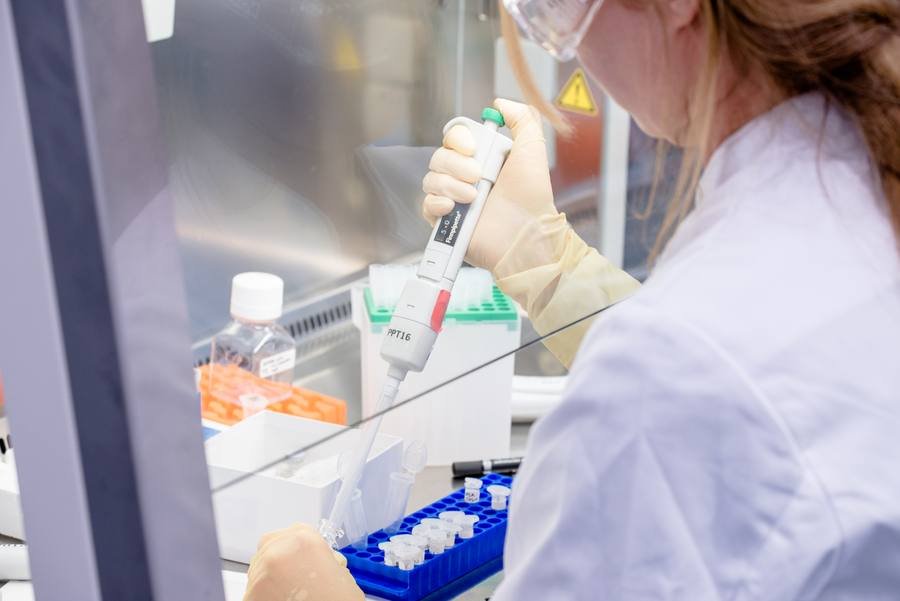
Formulation sample preparation at the Coriolis Pharma laboratory, Munich.
A pattern that repeats across nucleic acid development programmes is the tendency to deprioritise pharmaceutical acceptability in the early stages, when biological attributes such as potency and in vivo stability naturally command attention. The risk is that a molecule is taken deep into development before anyone has established whether it is actually formutable into a stable, manufacturable product.
The key questions that need answers before clinical studies begin are consistent across modalities: what delivery system, if any, is required; what storage conditions are acceptable; what are the chemical and physical degradation pathways; and what excipient composition, pH and concentration will meet the target product profile. None of these questions becomes easier to answer the later they are asked. The stability picture varies considerably by modality. ASOs are among the most robust, with some products stable in liquid form at ambient temperatures. mRNA is substantially less stable, with both the molecule and its lipid nanoparticle carrier contributing to the challenge. LNPs are, as Kersten frames it, unstable by design: their pH-sensitive ionisable lipids need to change character inside the endosome to release their payload, and that same sensitivity creates instability challenges during storage. The ribonucleoprotein complex used in some CRISPR-Cas applications is highly stable, while the guide RNA component is intermediate.
“Formulation optimisation is essential for drug product development and should not start too late. If you have a product that is not developable, then it’s a dead end.”
Prof Dr Gideon Kersten, Director Scientific Affairs, Coriolis Pharma
Terminal steam sterilisation is the preferred sterilisation method for drug products under both EMA and FDA guidance. For biologics and most large-molecule formats it is simply not an option: the heat involved destroys the product. For antisense oligonucleotides the picture is more nuanced. ASOs may tolerate autoclaving at 120 degrees, but the outcome is product-specific and must be demonstrated analytically rather than assumed. Data presented from a Coriolis study comparing two ASO products makes the point clearly. ASO1 showed no meaningful change in full-length product peak area after terminal sterilisation, with sub-visible particle counts remaining negligible. ASO2, tested across two formulations, showed a significant reduction in full-length product and sub-visible particle counts reaching up to 200,000 per millilitre in the worst case, with visible particle formation detectable by the naked eye. The two products behaved completely differently under identical conditions. The practical consequence is direct. ASO1 can proceed through a terminal sterilisation manufacturing pathway. ASO2 requires aseptic processing, with the associated regulatory justification and manufacturing investment that entails. Establishing this early, rather than at the point of manufacturing process design, is the difference between a planned decision and an expensive pivot.
For mRNA and other large nucleic acids delivered via lipid nanoparticles, two formulation parameters are in tension from the outset: particle size and nucleic acid payload. The 0.2 micron sterile filtration step required for aseptic processing sets a practical ceiling, making particles of approximately 100 nanometres the operational target. Maximising the amount of nucleic acid that can be encapsulated within that size constraint is the formulation challenge.
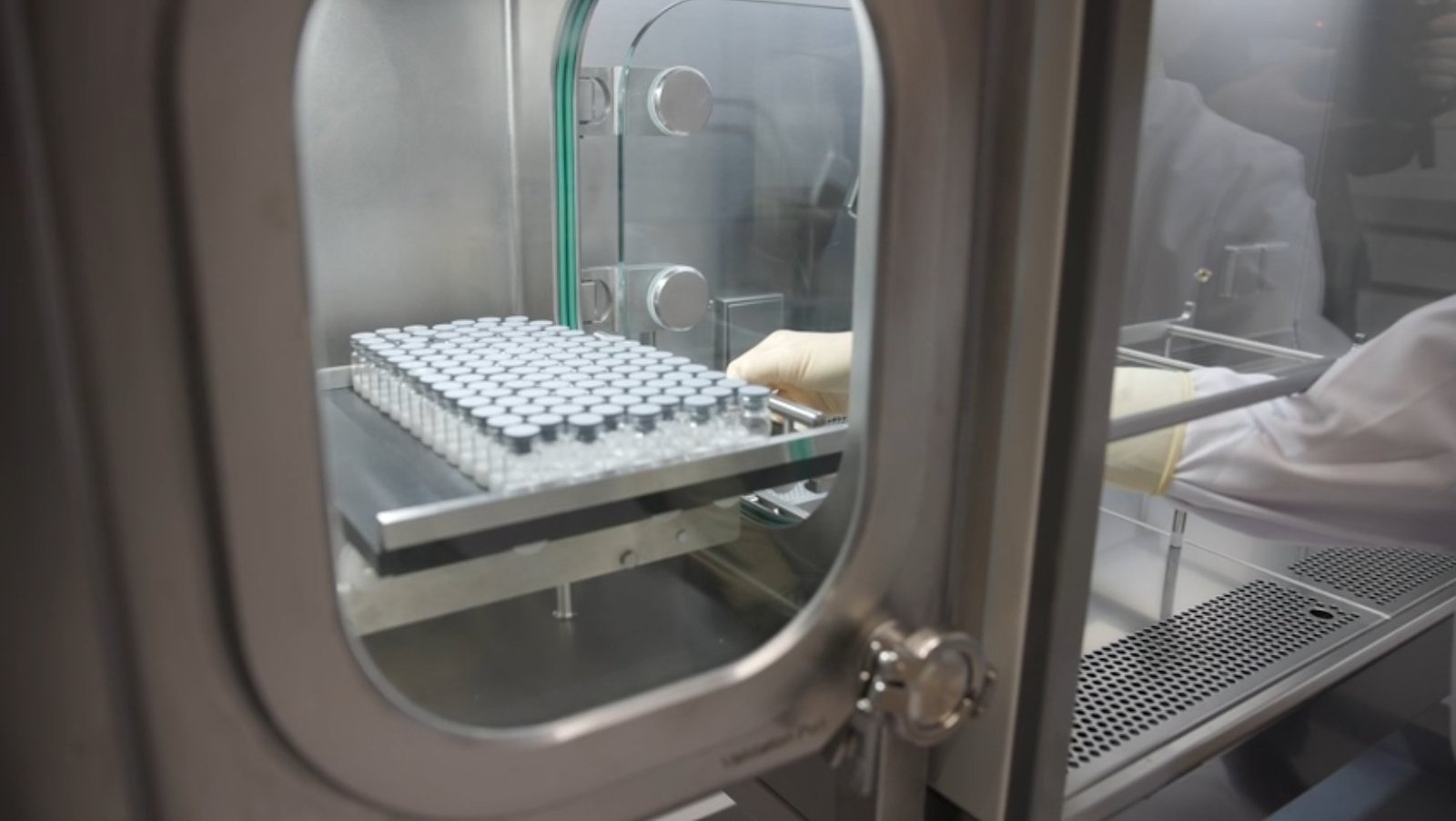
Vials loaded onto lyophiliser shelves during a freeze-drying feasibility study, Coriolis Pharma.
Data from a Coriolis LNP optimisation programme showed that formulation composition, including buffer, pH and excipient selection, had a material effect on both particle diameter and encapsulation efficiency. Of four formulations tested, only one achieved the target size range while maintaining 100% encapsulation efficiency across both small and large scale production. Scalability of the process itself, comparing laboratory bench mixing parameters against scale-up conditions, was confirmed for the selected formulation with acceptable size variance. A lyophilisation feasibility study run on the same formulation demonstrated that transition from frozen liquid to lyophilised product is achievable without compromising encapsulation efficiency or particle characteristics. Cake appearance, moisture content and reconstitution time all met acceptable criteria. For programmes where ultra-cold chain logistics represent a commercial or access barrier, this route is worth evaluating early rather than as a late rescue strategy.
“It is always important to combine analytical methods to ensure data-driven selection of the final formulation. The trends can be different, and you need the complete picture.”
Dr Anna Gebhardt, Business Development Manager, Coriolis Pharma
The Analytical Approach That Makes the Difference A consistent theme across all three case studies presented by Gebhardt is the importance of combining multiple analytical methods rather than relying on any single readout. HPLC provides information on full-length product integrity. Microflow imaging characterises sub-visible particles. DLS gives particle size distribution and PDI for nanoparticle systems. Visual inspection, pH, osmolality and encapsulation efficiency complete the picture. The reason this matters is that different degradation modes manifest differently across methods. A formulation that appears stable by chromatography may be generating sub-visible particles that only appear in MFI data. A particle size that looks acceptable in isolation may be accompanied by a polydispersity index that signals a problematic distribution. No single technique captures the full stability picture, and the decision on which formulation to progress should be data-driven across all available dimensions.Coriolis Pharma works across all nucleic acid modalities from early feasibility through to clinical supply, applying this multi-method analytical framework to formulation development, sterilisation assessment and lyophilisation optimisation. The consistent message from its scientific team is that the decisions which most constrain late-stage development are the ones made, or not made, in the earliest phases of a programme.
Watch the webinar on demand Professor Dr Gideon Kersten and Dr Anna Gebhardt presented these case studies in full at a Pharma D-mand webinar. The replay is available now via the Pharma D-mand webinar library. For organisations working on nucleic acid therapeutic formulation, sterilisation strategy or lyophilisation development, the Pharma D-mand advisory team can connect you with the relevant expertise.