
The failure rate for biologic drug candidates in late-stage development remains persistently high, and a significant proportion of those failures trace back to properties that were knowable much earlier. In silico modelling addresses this directly by generating molecular-level insight from nothing more than a protein sequence, before any material is synthesised, before any lab experiment is run and weeks ahead of the timelines that physical characterisation requires. The question is no longer whether these tools are technically ready. It is whether development teams are integrating them early enough to capture the advantage.


Developability assessment is the discipline of evaluating a drug candidate’s biophysical properties at the earliest possible stage to determine whether it is likely to survive formulation development, manufacturing and clinical use. The concept was given substantial empirical grounding by a 2017 study published in PNAS, which examined the biophysical properties of marketed monoclonal antibodies and found that approved products consistently displayed fewer biophysical red flags than candidates still in clinical development. The implication is clear: molecules with favourable properties are more likely to reach the market, and identifying those properties early reduces the cost and risk of the development programme.
The properties that matter are well defined. Thermal and conformational stability, measured by metrics such as melting temperature, determine whether a molecule can withstand the conditions of manufacturing and storage. Colloidal stability, assessed through self-interaction parameters such as the diffusion interaction parameter, determines whether the molecule will aggregate at the concentrations required for subcutaneous delivery. Chemical liabilities, including asparagine deamidation, methionine oxidation and aspartate isomerisation, determine whether the molecule will degrade during storage on a timescale relevant to shelf life. Each of these properties is measurable in the laboratory, but doing so requires material, time and an established assay infrastructure. In silico methods can generate predictive signals for all of them from sequence alone, weeks or months before the first batch arrives.
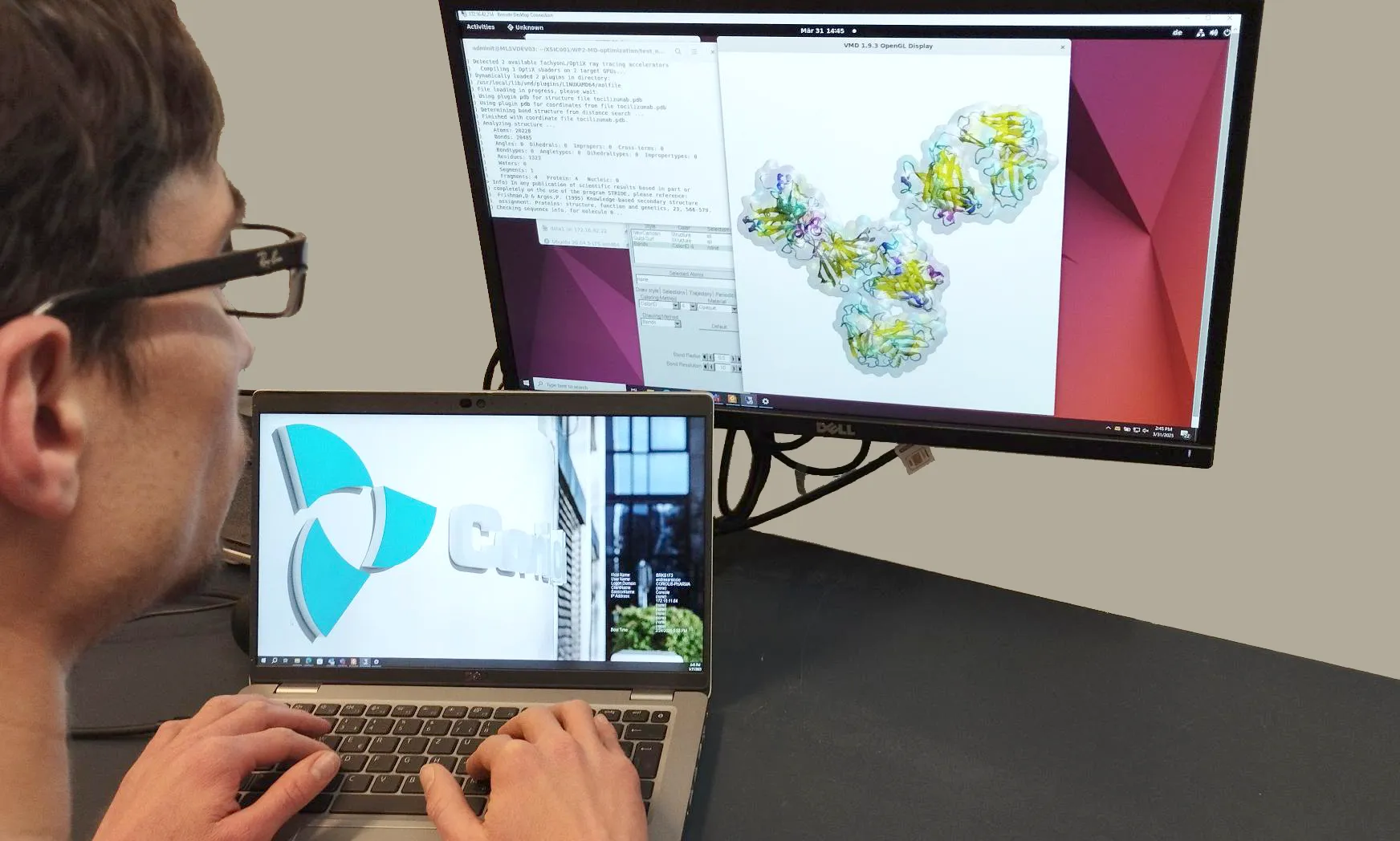
Molecular dynamics simulation in progress at Coriolis Pharma, with antibody structure visualisation.
The in silico platform at Coriolis combines three distinct types of computational tool within an automated pipeline. The first layer consists of sequence and structure-derived descriptors: numerical properties computed from the protein sequence or a predicted structural model, covering isoelectric point, protonation curve, hydrophobic and charged surface patches, aggregation propensity and conformational stability indicators. These descriptors correlate with known developability liabilities and can be benchmarked directly against a database of more than 600 marketed and clinical-stage proteins, allowing immediate identification of outlier properties relative to approved products.
The second layer applies machine learning models trained on curated experimental datasets to classify candidates for specific liabilities. Coriolis has trained multiple models covering self-association propensity, viscosity at high concentration, asparagine deamidation, methionine oxidation and aspartate isomerisation. These models are fast and require no structural input beyond what can be predicted from sequence, making them well suited for early screening of multiple candidates in parallel. The third layer uses molecular dynamics simulations to assess protein-protein interactions at atomistic resolution. Coriolis has developed a custom force field tuned specifically to reproduce experimental self-association propensities in different formulation conditions, and validated it against a set of 19 monoclonal antibodies with known self-association behaviour. The practical output is a prediction of whether a given molecule will self-associate at a given pH and ionic strength, and whether that behaviour can be resolved by adjusting the formulation. A typical formulation condition can be evaluated overnight, making it practical to screen multiple pH and excipient combinations within a compressed timeline.
“There is no model without the risk of false positives or negatives. We are far from replacing all in vitro work with in silico models. What we do is add these tools to the work we do in the lab to further de-risk it and to shift timelines so we can generate insight before material is even in hand.”
Tim Menzen, Chief Technology Officer, Coriolis Pharma
A case study involving three monoclonal antibody candidates illustrates how the platform is applied in practice. The objective was to determine which candidate offered the most favourable development profile and what formulation corridor was appropriate for each. The in silico analysis began with isoelectric point prediction from the folded and unfolded conformations of each antibody. MAb 2 displayed a notably low isoelectric point, a finding subsequently confirmed by experimental measurement via imaged capillary isoelectric focusing with good quantitative agreement, demonstrating that for this descriptor, the in silico prediction can in some cases replace the laboratory measurement entirely.

Integrated computational and laboratory capabilities, Coriolis Pharma biologics development team.
Conformational stability descriptors placed all three candidates above average relative to the internal database of clinical and marketed products, a prediction confirmed by nanoDSF measurements showing melting temperatures above 65 degrees Celsius for all three. Machine learning models then identified distinct liability profiles: MAb 1 showed elevated deamidation risk, while MAbs 2 and 3 were flagged for self-association and viscosity at high concentration, with MAb 2 additionally identified as at risk for oxidation. These predictions were validated by short-term stability data showing a pronounced decrease in main species for MAb 1 under accelerated conditions, and by diffusion interaction parameter measurements confirming self-associating behaviour for MAb 2 and
intermediate behaviour for MAb 3.
For the two self-associating candidates, the question of whether formulation adjustment could resolve the problem was addressed by molecular dynamics. For MAb 2, simulations across a range of pH values and ionic strength conditions found no conditions under which the self-association metric fell below the cutoff threshold, raising a firm formulatability red flag. For MAb 3, simulations showed that mildly acidic conditions at pH 5 to 6 with minimised ionic strength were sufficient to bring the self-association metric within acceptable bounds, providing a specific and actionable formulation direction. These conclusions were reached before any formulation screening experiment had been conducted, compressing the timeline from candidate selection to formulation decision by weeks.
A second case study for a non-antibody therapeutic protein demonstrated comparable methodology applied to a single candidate. Machine learning models found no significant deamidation or oxidation risk, but flagged elevated aggregation propensity and hydrophobicity. Molecular dynamics screening
across pH values in the presence of sucrose, sodium chloride and sucrose-sodium chloride combinations predicted that low pH combined with low ionic strength minimised intermolecular contacts. For the sake of precision, the study was conducted at 37 °C, with results closely matching the computational output. From sequence receipt to final report including all computational analysis, the typical turnaround for a full in silico characterisation is three to four weeks.
“In our opinion, the combination of data-driven and physics-based models allows a comprehensive characterisation of the protein candidate. Machine learning models are fast and do not require deep mechanistic understanding. Molecular dynamics allows extrapolation and can evaluate the effect of formulation conditions in a way that machine learning cannot.”
Andrea Arsiccio, Senior Scientist, Coriolis Pharma
Coriolis Pharma is a Munich-based CRDO specialising in biologics drug product development, analytical characterisation and lyophilisation. The in silico platform described here has been developed internally and is continuously extended to cover additional modalities beyond monoclonal antibodies, including bispecific antibodies, nanobodies, antibody-drug conjugates and other therapeutic proteins. The platform operates from sequence input with no material requirement, and outputs include a full technical report benchmarking the candidate against the internal database of clinical and marketed proteins with specific formulation corridor recommendations.
Watch the webinar on demand The full presentation on in silico modelling for smart drug development, including both case studies and a detailed walkthrough of the molecular dynamics validation methodology, is available on demand via the Pharma D-mand webinar library.