
The buccal mucosa is among the most accessible and underused routes in pharmaceutical drug delivery. A muco-adhesive buccal film applied to the inside of the cheek can bypass first-pass liver metabolism, deliver therapeutic effect within minutes and achieve bioavailability of between 30 and 80 per cent, depending on the API and formulation. Understanding whether a given molecule is a candidate for this route begins with five physicochemical criteria and a structured feasibility process that can generate meaningful data in weeks.

Most drugs that fail to reach adequate systemic concentrations via the oral route do so for one of two reasons: degradation in the gastrointestinal tract or extensive first-pass metabolism in the liver. The buccal route sidesteps both. Drug absorbed through the buccal mucosa enters the bloodstream directly via the submucosal vasculature, avoiding the GI environment entirely and bypassing hepatic metabolism. The result is faster onset, more predictable pharmacokinetics and, in many cases, a lower effective dose. The practical advantages extend to the patient experience. Buccal films require no water, no swallowing and no reconstitution. They are particularly well suited to paediatric and geriatric populations, to acute and emergency indications where rapid onset is essential, and to drugs where patient adherence is a persistent clinical challenge. From a lifecycle management perspective, repositioning an approved API into a buccal film format offers a clear path to new IP, an extended commercial window and potential 505(b)(2) regulatory eligibility. The platform is not limited to small molecules. Work conducted at Labtec has demonstrated successful incorporation of EGF, a hydrophilic protein of approximately 6,200 Daltons, into muco-adhesive films with ex vivo permeation through human oral mucosa. mRNA lipid nanoparticle vaccines have been formulated into bilayer buccal films and tested in vivo in mice. The range of molecules deliverable through this route is considerably broader than its historical small-molecule applications suggest.
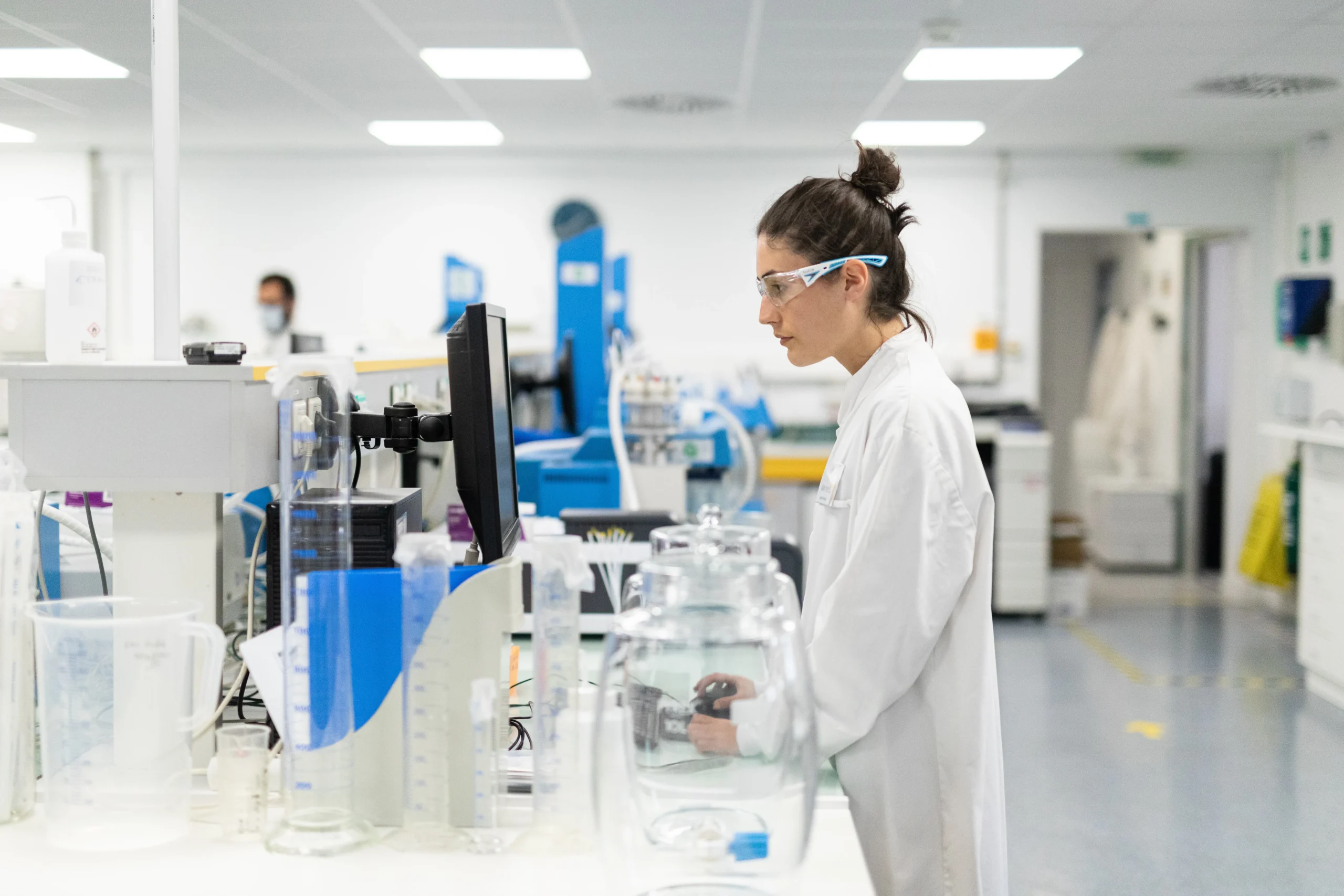
Precision at every stage: an Adhex Pharma scientist handles formulation samples in the company’s state-of-the-art research laboratory.
The buccal mucosa presents a lipid-based diffusion barrier formed by membrane-coated granules in the upper epithelial layers. These granules migrate to the cell membrane and release lipids into the intercellular spaces, creating a barrier that governs the passage of both hydrophilic and lipophilic molecules. Understanding how a given API interacts with this barrier is the foundation of buccal feasibility assessment.
Five physicochemical criteria determine whether an API is a viable candidate. Molecular weight should ideally be under 500 Daltons, which allows passage through the intercellular spaces, though larger molecules including biologics can be absorbed under the right formulation conditions. Lipophilicity, expressed as log P, should fall between minus 1 and 3: too lipophilic and the molecule becomes trapped in the non-polar lipid regions; too hydrophilic and it cannot cross the lipid barriers. The ionisation state in saliva, which has a pH of around 6.5 to 7, is important because weak bases at this pH exist in partial equilibrium between ionised and neutral forms. The ionised fraction remains soluble in the mucosal environment while the neutral fraction crosses the lipophilic barriers, creating a continuous absorptive flux. Dose should generally not exceed 30 milligrams, and sufficient aqueous solubility in the salivary environment is required. BCS Class 1 is optimal; Class 2 and 3 require solubility and permeability enhancement strategies respectively; Class 4 demands more advanced approaches. Lidocaine illustrates all five criteria in alignment: molecular weight of 234 Daltons, log P of 2 to 3, pKa of 7.9 giving approximately 56 per cent neutral form at physiological pH, BCS Class 2 with high permeability, and typically administered at low doses. This combination produces efficient buccal absorption and explains both its local anaesthetic applications and its use as a reference compound in permeation studies.
“Only drugs with the right physicochemical properties can pass through the mucosa efficiently. Understanding those properties before formulation work begins is what makes development move quickly.”
Marion Tegelkamp, Head of CMC and Corporate QC, AdhexPharma
A buccal film is more than a drug-loaded polymer strip. Its architecture determines the direction of drug release, the duration of contact with the mucosa, the rate of drug delivery and patient tolerability. A bilayer film consists of a biocompatible backing layer, which prevents drug loss into the oral cavity and directs release toward the mucosa, and a drug matrix layer that controls release rate and ensures contact with the absorptive surface. This unidirectional design is the standard for systemic buccal delivery. A single-layer film releases drug in both directions and is more appropriate where buccal or sublingual action is the objective. Film size and thickness require careful calibration. Too large and the film is uncomfortable, stimulates excess saliva and risks displacement; too small and drug loading is insufficient or adhesion is compromised. The polymer backbone, typically a hydrophilic material such as HPMC, PVA or chitosan, must provide both adequate mechanical properties and strong mucoadhesion. Plasticisers such as glycerol or PEG are incorporated to control flexibility. Permeation enhancers, pH modifiers, flavours and taste-masking agents complete the formulation, each selected with reference to the target patient population and the API’s own constraints.
Development begins at the paper feasibility stage, where the API’s properties are assessed against the buccal suitability criteria, target product profile requirements are defined and preliminary formulation concepts are identified. This stage also reviews manufacturing feasibility, regulatory considerations and the patient population characteristics that will influence film design. It takes days, not months, and provides the go or no-go foundation for everything that follows.
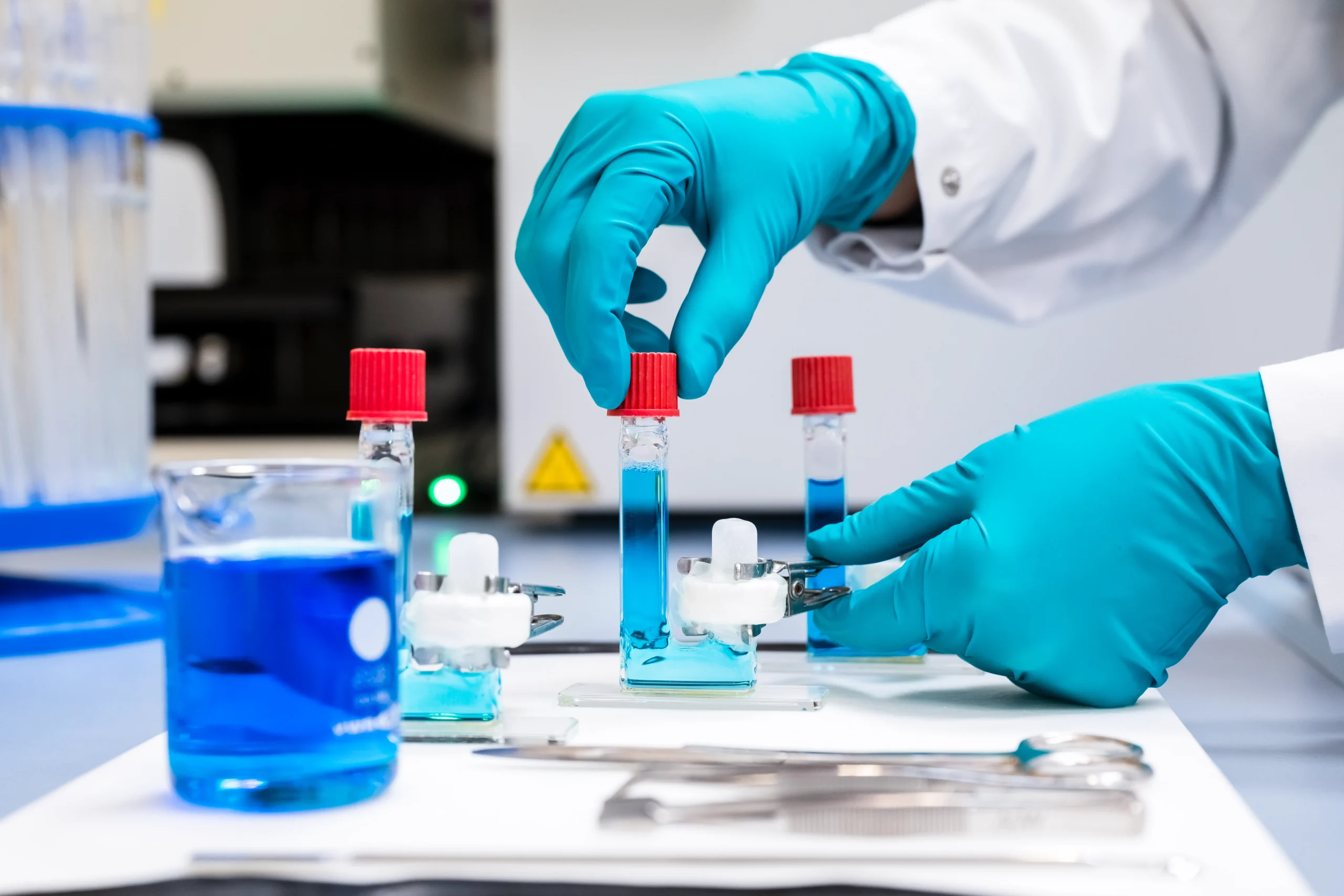
Where science meets rigour: an Adhex Pharma researcher at work in the company’s modern analytical laboratory facility.
Lab feasibility moves to empirical data. API characterisation is completed, polymers and excipients are screened for performance and acceptability, and initial films are produced via solvent casting on a laboratory coating bench. Content uniformity, purity, excipient compatibility, mechanical strength and moisture content are measured. Critically, ex vivo permeation studies using porcine buccal tissue in diffusion cells provide the first realistic assessment of how the drug crosses the mucosal barrier. Labtec runs these studies in-house with automated sampling and HPLC quantification, generating reproducible data that directly informs formulation decisions. Porcine buccal tissue is the accepted model for human oral mucosa and provides the mechanistic insight needed to de-risk the programme before significant investment is committed. Prototyping iterates on the lead formulation, adjusting additives, film thickness and area weight while building the analytical method suite and running short-term ICH stability studies. The validated prototype then moves to pilot manufacturing, where slot-die coating, batch or continuous drying, punching and packaging are scaled under GMP conditions to produce clinical trial supplies. Commercial scale manufacturing at the AdhexPharma facility in France uses the same platform, allowing flexible batch sizes and secondary packaging without a process redesign at the transition from clinical to commercial production. The entire pathway from formulation through GMP clinical supply is managed under one roof, which is where the meaningful time saving is found.
“The speed comes from doing analytics, ex vivo studies, pilot manufacturing and GMP supply under one roof. That removes handoff delays and gives customers a single point of accountability across the whole development path.”
Marion Tegelkamp, Head of CMC and Corporate QC, AdhexPharma
AdhexPharma and Labtec together form an end-to-end CDMO for planar dosage forms, with a manufacturing site in France, an R&D centre in Germany and additional offices in Paris and Munich. Both sites are European GMP approved and have passed US FDA inspection. Controlled substance handling is supported across the full capability range.
The full presentation on transmucosal delivery and muco-adhesive buccal film development is available on demand via the Pharma D-mand webinar library. For organisations assessing whether the buccal route is right for their API, or looking for a CDMO partner with integrated development and GMP manufacturing capability, the Pharma D-mand advisory team can connect you with the relevant expertise.